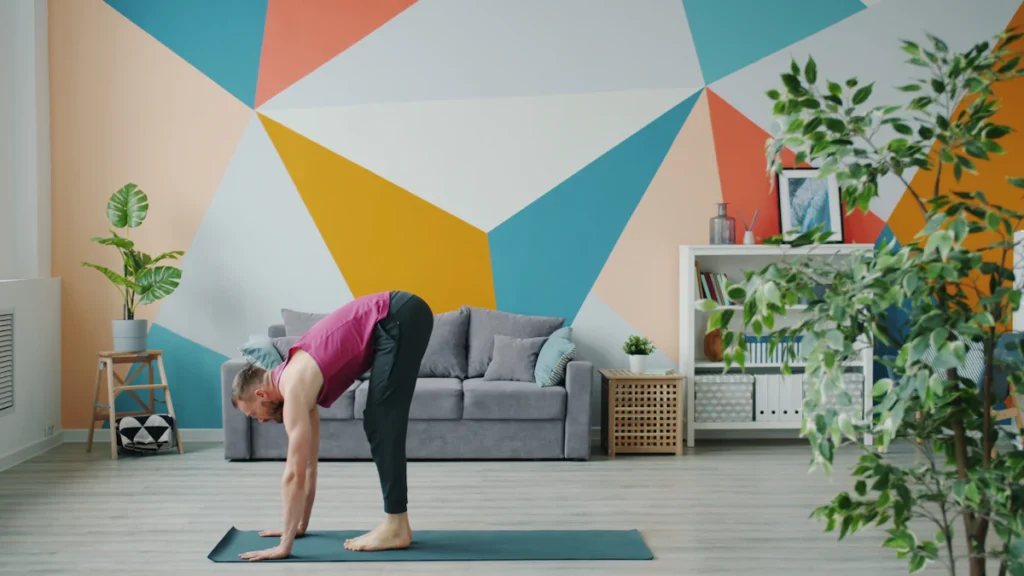
A silent zero equipment 30 minute workout designed specifically for small spaces and thin walls. Build strength. Get your heart rate up without any jumping, bouncing or noise complaints.
Working Out in an Apartment Does Not Have to Annoy Your Neighbors.Living in an apartment comes with a lot of benefits. Figuring out how to fit in a good workout without sounding like a group of elephants is rarely one of them. If you have ever lived on a floor you probably know the hidden worry that comes with trying to exercise at home. You want to get your heart rate up and break a sweat. The second a fitness instructor on your screen shouts out “Burpees!” or “Jump squats!” you immediately stop. No one wants to be that upstairs neighbor who shakes the ceiling fixtures at six in the morning or late at night. The fear of getting a noise complaint from the people living below you is a real obstacle that stops so many people from staying consistent with their fitness routines.
We have been completely conditioned by the fitness industry to believe that an effective cardio or fat-burning session has to involve plyometrics. We are told we need to bounce, jump and stomp our way to a body.. What if I told you that you could get a seriously effective pulse-pounding workout without your feet ever slamming against the floor? This thirty minute apartment-friendly full body workout is designed specifically for small spaces and thin walls. It requires no equipment makes almost no noise and is easy on your joints.. Even though it is completely grounded the steady pace is going to keep your heart rate up the entire time proving once and for all that a quiet at-home session can still make you work hard.
The Magic of Steady Tension Over High Impact
One of the misunderstandings in the fitness world is that if you are not jumping around and gasping for air you are not doing enough. People often confuse impact with effort. Impact is the mechanical force your joints absorb when you hit the ground. Effort is how hard your muscles and cardiovascular system are actually working.
By focusing on continuous movement you can create a lot of metabolic stress without the harsh impact. When you remove the jumping you eliminate the momentum. Without momentum your muscles are forced to do all the lifting controlling the movement through the entire range of motion. This increases your ‘time under tension’ which’s a fancy way of saying your muscles are working longer and harder.This exercise burns 230 calories in thirty minutes. That makes it a great way to get stronger and more fit. You can do it in your living room. You won’t wake the baby in the room. You also won’t bother the people who live below you.
Phase 1. The Silent Warm-Up (2 Minutes)
This exercise routine is pretty good. Skipping the warm-up is not a good idea. The muscles in your body are like rubber bands. If they are cold and tight they are more likely to get hurt. This warm-up gets the special fluid in your joints moving. It helps your body get warmer slowly.
• Standing March, with Arm Reach (60 seconds): Stand up in the middle of your room. Start marching in place. Lift your knees up toward your chest, one knee at a time. This is part of the warm-up routine the warm-up routine is important. The warm-up routine helps your muscles the muscles need to be warm before you start exercising.. To make this a full body movement reach the arm straight up toward the ceiling as each knee rises. It is a rhythmic motion that gently increases your heart rate and gets your blood flowing without a single footstep thudding against the floor.
• Ankle Circles (30 seconds): Balance on your leg. Lift your foot slightly off the ground and draw large slow circles with your big toe. Do this for 15 seconds clockwise then switch directions for another 15 seconds. Switch to the foot. Having ankles is surprisingly important for getting deep into lunges safely.
• Torso Twists (30 seconds): Plant your feet a bit wider than your shoulders. Let your arms hang relaxed by your sides. Gently twist your body from left to right allowing your arms to naturally wrap around your torso. This movement loosens up a lower back and prepares your core for the upcoming stability work.
Phase 2. The Main Workout Circuit (20 Minutes)
This is where the real sweat happens. You are going to perform these four exercises one after another. Work for the set amount of time on each move. Only rest for 20 seconds after you finish the fourth exercise. You will repeat this block for a total of 4 rounds.
• Static Lunges (40 seconds per side): Step your foot forward and your left foot back. Keep your chest up. Slowly lower your hips straight down until both knees are bent at a 90-degree angle. Push through your heel to stand back up but do not move your feet from their staggered position. Staying in this stance keeps constant tension on the legs. Do 40 seconds on the leg then switch to the left. Your quads will be on fire. You won’t make a sound.
• Standing Oblique Crunches (40 seconds per side): Stand tall. Place your right hand lightly behind your head. Shift your weight to your leg. Bring your knee up and out to the side while crunching your upper body down trying to tap your right elbow to that right knee. Focus on squeezing the side of your stomach. Do 40 seconds on the side then 40 seconds on the left.
• Wall Sit (30 seconds): Find a spot on your wall. Press your back flat against it. Slide down until your thighs are parallel to the floor forming a 90-degree angle with your knees. Keep your weight in your heels. Tighten your core. Hold this completely still for 30 seconds. It is purely isometric meaning your muscles are contracting without moving making it a silent way to build strong lower body endurance.
• Standing Bicycle Crunches (40 seconds): Place both hands lightly behind your ears. Bring your knee up and across your body while twisting your torso to bring your left elbow down to meet it. Return to the start. Switch sides. This mimics a floor bicycle crunch. Keeps you on your feet removing the awkwardness of getting up and down off the floor while maintaining a solid cardio pace.
Phase 3. Cooldown and Decompression (2 Minutes)
Do not just fall on the couch the second you finish your round of standing crunches. Your body needs a minute to return to a resting state.
• Figure-Four Stretch (30 seconds per side): You can do this sitting on a chair or the edge of your couch. Cross your ankle over your left knee. Sit up straight and lean forward slightly at the hips until you feel a deep stretch in the outside of your right glute. This is great for reducing tension in the hips after all those lunges. Switch sides after 30 seconds.
• Standing Quad Stretch (30 seconds per side): You need to hold onto a wall so you do not fall. Then you grab your foot. Gently pull your heel towards your glutes. Make sure your knees are close together. This helps get rid of the tension in the front of your thighs from doing the wall sits. The Standing Quad Stretch is really good, for your thighs.
• Slow Breathing (60 seconds): Now you should sit down. Close your eyes. Just focus on breathing. Breathe in through your nose and your stomach will get bigger. Then breathe out slowly through your mouth. The Slow Breathing exercise is great because it calms your body. When you do the Slow Breathing exercise it officially ends the workout. You can stop doing the Standing Quad Stretch and other exercises.
Coachs Advice on Mastering the Wall Sit
Let us be honest: the wall sit is usually the part of this workout that people do not like. Thirty seconds might not seem like a time but when your thighs are burning and shaking it can feel like it is going on forever. If you find that holding a wall sit for the thirty seconds is just too much, for you right now please do not feel discouraged and do not give up on the wall sit. The wall sit is tough. You can get better at the wall sit with practice. Of sliding down the wall or giving up completely just adjust the time. Aim for 15 to 20 seconds during your few tries. Once that feels easier try adding five seconds the week. Fitness is, about gradual progress and giving your body time to adapt. By increasing your hold time over a few weeks you will safely build the strength needed to conquer the full 30 seconds without hurting your knees